Use case
DER visibility & operations
Interconnection at the speed the queue demands
Automated hosting-capacity screens cutting study time 70% and tripling interconnection throughput.


Solar and storage are interconnecting faster than most utilities can process the paperwork.
The Challenge
A municipal utility with rapidly growing rooftop solar faced a 14-month interconnection queue. Hosting capacity studies were manual: engineers ran load flow models one feeder at a time, with inconsistent assumptions across analysts. Planners lacked feeder-level headroom visibility under realistic heat and cloud scenarios, and developers escalated delays to the public utility commission. The utility needed to triple throughput without tripling engineering headcount.
The Innovoco Solution
We automated hosting capacity screens by combining load flow snapshots, inverter telemetry, and scenario libraries into a platform that pre-screens applications, flags feeders approaching limits, and produces planner-reviewable reports with override capabilities and audit logs.

Phase 1 — Scenario library and baseline automation
Built a library of load flow scenarios (peak load, minimum load, high-solar, cloud transient) calibrated to the utility's feeder models. Automated the technical screen for standard residential and small commercial applications against pre-computed hosting maps.

Phase 2 — Real-time visibility and queue management
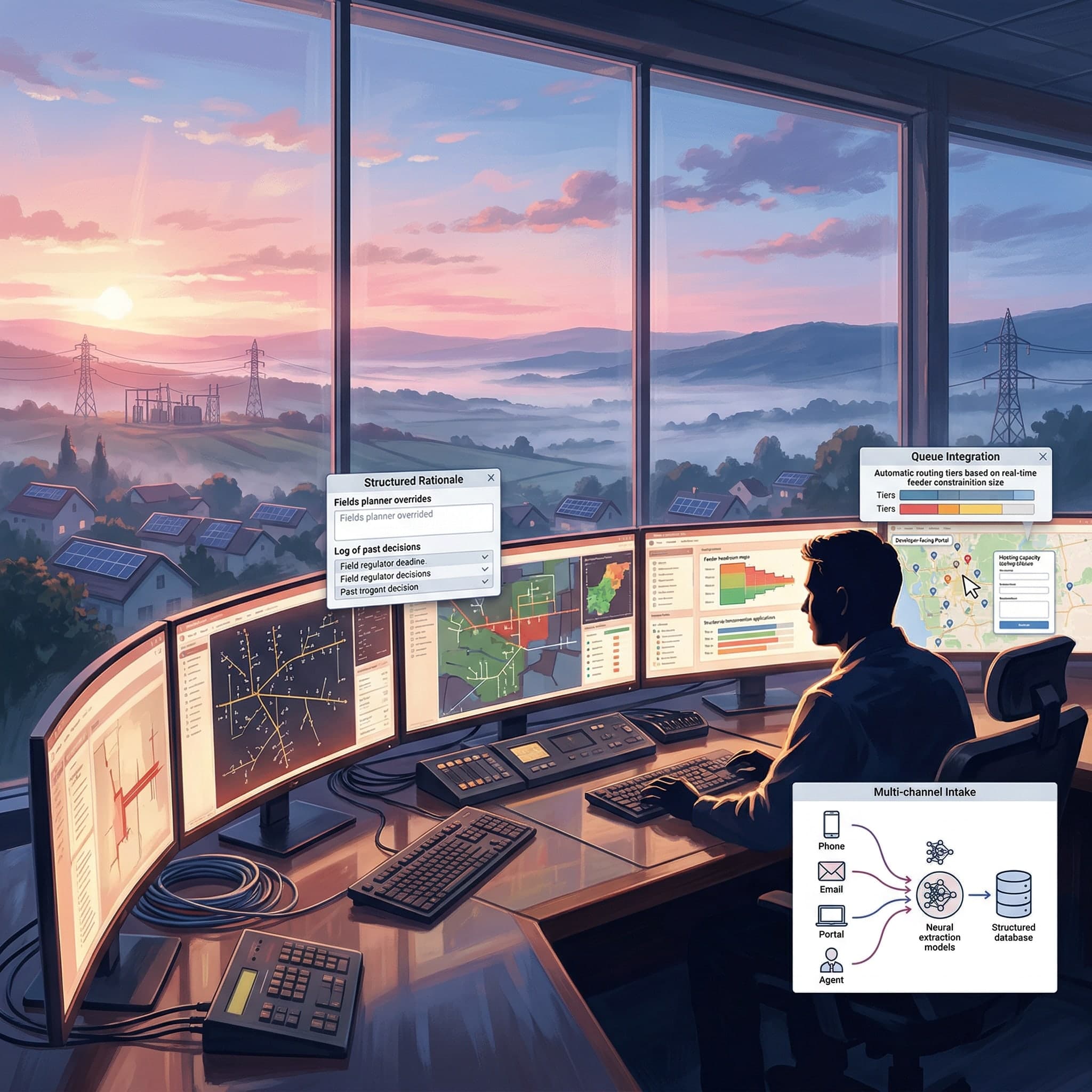
Connected inverter telemetry and AMI net-load to update hosting headroom in near-real-time. Integrated with the interconnection queue system so applications route automatically to pre-screen, detailed study, or planner review based on feeder status.
Key implementations
Pre-computed hosting maps
Feeder-level hosting capacity updated nightly from latest load flow results and telemetry, enabling instant pre-screening of standard applications.
Scenario-based stress testing
Automated runs for heat, cloud, and coincident-DER scenarios surface feeders approaching limits before applications arrive.
Planner override and audit
Engineers can override automated decisions with structured rationale; every override is logged for regulatory transparency.
Queue integration
Interconnection applications route to the appropriate study tier automatically based on feeder headroom and application size.
Developer-facing portal
Self-service hosting capacity lookup by location, reducing pre-application inquiries and setting realistic expectations before formal submission.
Technical Innovation
Pre-computed hosting maps avoid the bottleneck of on-demand load flow runs for standard applications. A lightweight orchestration layer triggers detailed studies only when pre-screens identify potential constraint violations, concentrating engineering time where it adds value.


Impact
- 70% reduction in per-study engineering time through automated pre-screening.
- 3x interconnection throughput without additional engineering headcount.
- Zero critical voltage or thermal violations on approved interconnections.
- Queue backlog cleared from 14 months to under 4 months within two quarters.
Engineers spend their time on complex studies that require judgment—not routine screens that a well-calibrated model handles faster and more consistently.

Explore this outcome on your stack
We map scope, guardrails, and rollout to your data boundaries and teams—practical next steps, not a generic slide deck.
60 min · Free · No obligation
More case studies
Explore adjacent patterns from the same production playbook.